
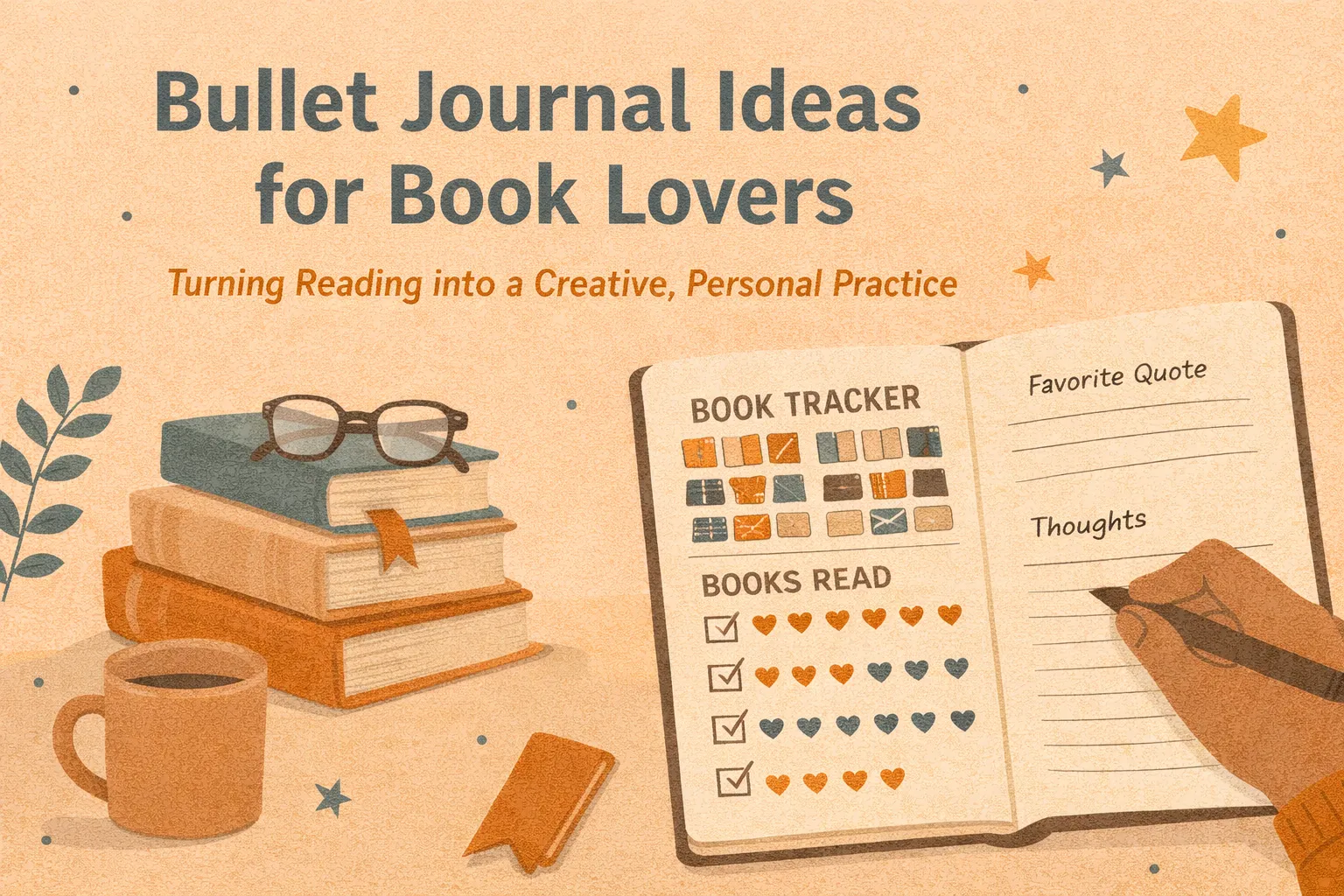
If you love books, you already know that reading is not just about finishing pages. It is about feelings, thoughts, questions, comfort, learning, escape, and sometimes even healing.
Many book lovers underline lines, dog-ear pages, or keep screenshots of quotes. A bullet journal (BuJo) gives you a beautiful, organized space to hold all of this together your reading life, your thinking, and your growth.
A bullet journal for book lovers is not about making pretty pages only. It is about creating spreads that match how you read and what you read.
A fantasy reader thinks differently from a non-fiction reader. A poetry lover connects with words in a different way than a thriller reader. That is why genre-based layouts matter.
The essence of a BuJo is this connection between your habits, your interests, and your inner world.
This article will walk you through meaningful, practical bullet journal ideas made especially for book lovers.
These ideas will help you track reading, reflect on stories, learn from books, and enjoy the process without pressure. You do not need to be an artist. You only need honesty, curiosity, and love for books.
Table of Contents
Why Book Lovers Need a Bullet Journal
Many readers read more than one book at a time. Some read slowly and deeply. Some read fast but forget details later.
Some read for pleasure, others to learn. A bullet journal becomes your personal reading companion. It helps you remember what you read, how it made you feel, and what it taught you.
Unlike apps, a bullet journal slows you down. Writing by hand helps you think. When you write about a book, you do not just consume it you respond to it. Over time, your journal becomes a record of your reading journey, showing how your taste, thoughts, and understanding have changed.
Most importantly, a BuJo lets you design pages that suit your reading style. There are no rules. You build spreads that feel natural to you.
Creating a Reading Identity Page
Before jumping into individual spreads, it helps to start with a “reading identity” page. This is not philosophical fluff. It is practical and grounding.
On this page, you can write what kind of reader you are right now. Not who you wish to be, but who you are. Do you read mostly fiction? Do you read at night? Do you abandon books easily? Do you reread favorites? Writing this helps you design realistic spreads later.
You can also note your favorite genres, authors you always trust, formats you prefer (paperback, hardcover, Kindle, audiobooks), and what reading gives you—comfort, knowledge, escape, or inspiration. This page sets the tone for everything that follows.
Genre-Based Reading Log (The Heart of a Book Lover’s BuJo)
Instead of a single boring reading list, divide your reading log by genres. This makes your journal more alive and more useful.
For example, if you love fiction, you can create separate sections for fantasy, romance, mystery, literary fiction, historical fiction, and science fiction. Each genre can have its own small design language. Fantasy pages may have stars, maps, or old-paper vibes. Romance spreads can be soft and warm. Mystery layouts can use darker shades and sharp lines.
For non-fiction readers, genres might include self-help, history, philosophy, psychology, biographies, and academic reading. Each genre serves a different purpose, so your layouts should reflect that.
In each genre section, instead of just listing book titles, leave space for short notes. Write why you picked the book, what mood you were in, and whether you would recommend it. This way, your log becomes a memory bank, not just a checklist.
Fiction Readers: Story-Focused Spreads
If you read fiction, your bullet journal should help you stay connected to stories and characters.
A very useful spread is a “story snapshot” page. After finishing a novel, write a short summary in your own words. Do not copy from the internet. Write as if you are telling a friend what the book is about. This helps your memory and understanding.
Another powerful layout is the character connection page. Choose one or two characters and write what you liked about them, what annoyed you, and what they taught you. This is especially useful for long novels or series where characters grow over time.
For fantasy and science fiction readers, world-building pages are gold. You can draw simple maps, list fictional places, note magic systems, or write timelines. This makes reading complex worlds easier and more enjoyable.
Mystery and thriller lovers can create prediction pages. Halfway through the book, pause and write who you think the culprit is and why. After finishing, come back and see how close you were. This makes reading interactive and fun.
Poetry Lovers: Feeling-Based Layouts
Poetry readers often connect deeply with emotions and language. Your bullet journal should give space for that softness.
Instead of long notes, create “poem response” pages. Write one or two lines from a poem that touched you, then write how it made you feel. Do not analyze too much. Let the response be honest and simple.
You can also dedicate pages to themes like love, loss, hope, nature, or identity. Under each theme, note poems or poets that fit. Over time, you will see patterns in what you are drawn to emotionally.
A beautiful idea for poetry lovers is a “words that stayed” spread. Whenever a word or phrase stays with you after reading, write it down. This slowly builds a personal vocabulary of meaningful language.
Non-Fiction Readers: Learning-Based Spreads
If you read to learn, your bullet journal becomes a powerful thinking tool.
For self-help or psychology books, create “idea application” pages. Instead of writing summaries, write how you will apply one idea in your life. For example, if a book talks about habits, note one habit you want to try this month.
History and biography readers can use timeline layouts. Write key events in order, but also add your reactions. What surprised you? What made you uncomfortable? This keeps reading active.
If you read academic or heavy non-fiction, create question pages. While reading, note questions that come to your mind. Some may get answered later. Some may push you to read more. This turns reading into exploration, not memorization.
Genre Mood Trackers (A Unique BuJo Idea)
This is where bullet journaling becomes truly personal.
Create a mood tracker that connects your reading mood with genres. For example, you might notice that you read fantasy when you are stressed, or poetry when you feel low, or non-fiction when you feel motivated.
Each time you read, mark the genre and your mood. Over time, patterns appear. This helps you understand yourself better and choose books that support your emotional needs.
Reading Goals That Feel Human
Many readers feel guilty for not reading “enough.” A bullet journal can reduce this guilt if used correctly.
Instead of setting huge yearly goals, try gentle goals. You might aim to read a little every day, or explore one new genre every month. Write these goals in a calm, encouraging tone, not as pressure.
You can also create a “slow reading” page where you give yourself permission to read slowly, reread, or pause. This is especially important for book lovers who read deeply.
Quote Collection Pages (Done the Right Way)
Almost every book lover loves quotes, but copying too many can feel empty.
Instead of writing dozens of quotes, choose only those that truly moved you. Next to each quote, write why it mattered. Did it describe you? Did it challenge you? Did it comfort you?
You can organize quote pages by genre, author, or emotion. This makes them meaningful, not decorative.
Book-to-Life Reflection Pages
One of the most powerful BuJo ideas for book lovers is connecting books to real life.
After finishing a book, ask yourself simple questions. What did this book change in me? Did it make me think differently? Did it give me courage, clarity, or peace? Write short answers.
This is especially useful for non-fiction and literary fiction, but even fantasy can teach values, resilience, and empathy.
Series and Re-Reading Trackers
If you love book series, create dedicated pages for them. Track which book you are on, your favorite moments, and characters you love.
For rereaders, create a “books I return to” spread. Write why you reread them and what they give you each time. This honors comfort reading, which is just as valuable as new reading.
Seasonal and Genre-Based TBR Pages
Your “to be read” list does not have to be stressful.
Instead of one long list, divide your TBR by seasons or moods. You may want cozy romances in winter, adventures in summer, or reflective books during exam or work stress.
You can also make genre-based TBR pages where you intentionally explore one genre you usually ignore. This keeps reading fresh.
Designing Without Pressure
A bullet journal for book lovers does not need perfect art. Simple boxes, lines, and handwriting are enough. The beauty comes from honesty, not decoration.
Use colors that match genres if you like, but do not force aesthetics. Some months your pages may be messy. That is okay. Reading itself is messy and emotional.
Remember, your journal is not for social media. It is for you.
Making Reading a Ritual
When you combine reading and journaling, reading becomes a ritual. You read, pause, reflect, and write. This deepens your connection with books and with yourself.
Over months and years, your bullet journal will show your growth as a reader and as a thinker. You will see how genres shaped you, how ideas stayed with you, and how books walked with you through different phases of life.
That is the true essence of bullet journaling for book lovers. It is not about tracking pages. It is about honoring the relationship between you and the stories that shape you.
If you love books and love writing your thoughts, your bullet journal can become the most personal library you will ever own.
