
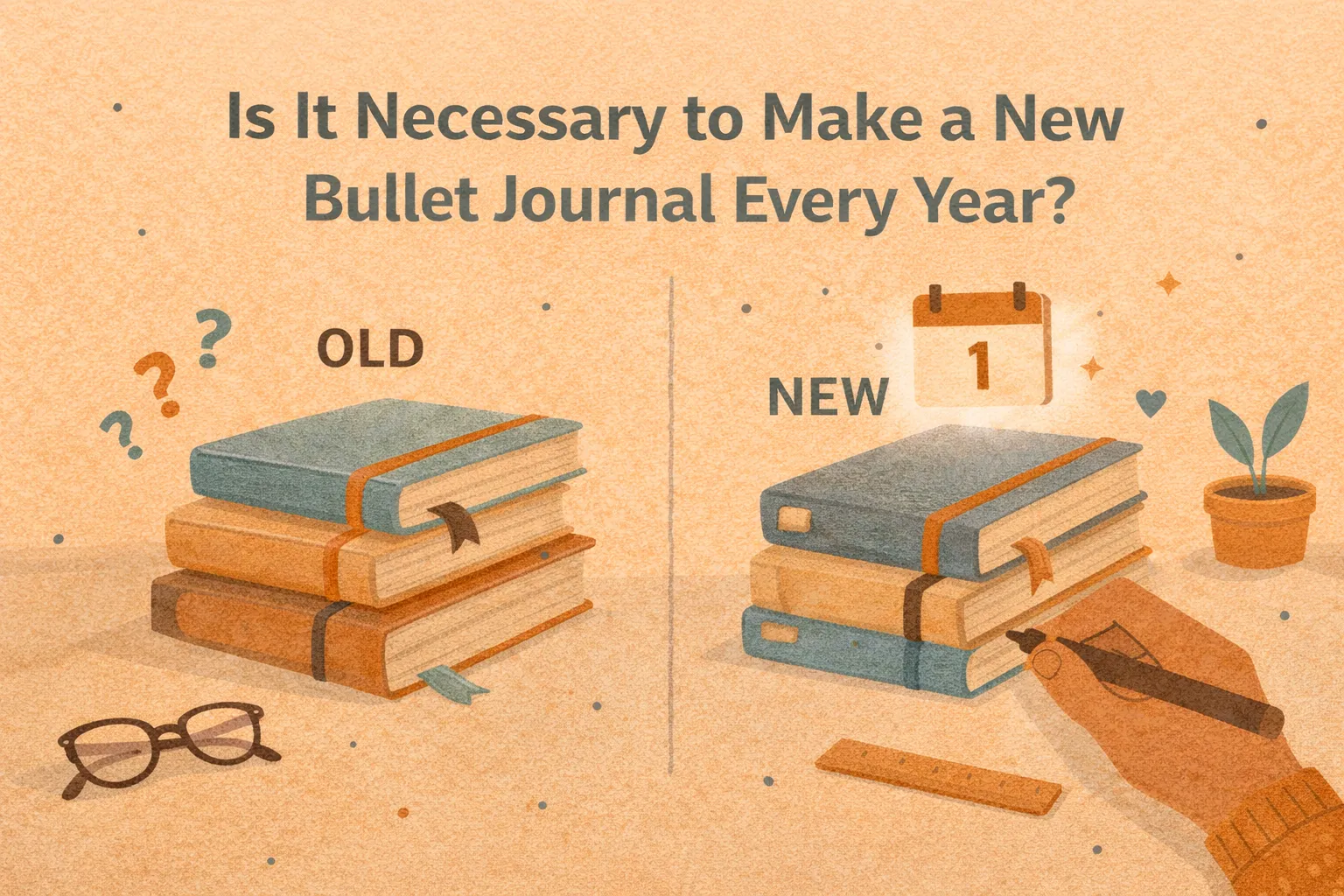
At the beginning of every year, many people who keep a bullet journal face the same question: Should I start a new one?
The new year often brings a sense of renewal, and with it comes an unspoken expectation that everything from goals to notebooks must begin again. Social media reinforces this idea, showing fresh covers, clean first pages, and carefully designed January spreads.
Over time, this repetition can make it feel like starting a new bullet journal every year is a rule rather than a choice.
But it is worth pausing and asking a more honest question: Is it actually necessary?
From my own experience, the answer is no. Starting a new bullet journal every year is not required. It is entirely a personal decision, and for some people including me continuing with the same journal makes more sense, not just practically but emotionally.
Table of Contents
A Bullet Journal Is Not Just a Planner
A bullet journal is often described as a planning system, but in reality, it becomes much more than that. Over time, it turns into a record of daily life. It holds unfinished to-do lists, small achievements, periods of exhaustion, moments of clarity, and quiet reflections that were never meant for anyone else to read.
Because of this, I do not see my bullet journals as yearly planners. I see them as volumes. Each journal represents a phase of my life rather than a fixed calendar year.
Like a book, a volume ends when the story reaches a natural stopping pointnot when the date changes.
If my current bullet journal still has pages left, I continue using it, even if a new year has begun. This choice is not about resisting change or avoiding new beginnings. It is about allowing my journal to reflect my life honestly.
Life Does Not Reset With the Calendar
One of the main reasons I do not start a new bullet journal every January is simple: life does not reset on the first day of the year. December does not suddenly end one version of me and January does not instantly create another.
For example, December 2025 moved into January 2026 without any dramatic shift in my life. There was no major event, no sudden emotional change, and no clear sense of closure.
I was the same person, dealing with the same thoughts and routines. In such a situation, starting a new journal felt artificial.
Continuing in the same notebook felt more honest. My bullet journal reflected the reality that nothing significant had changed and that was perfectly fine.
Emotional Continuity Matters
There is a strong emotional side to journaling that is easy to overlook.
- A bullet journal carries thoughts forward.
- It allows feelings to continue without interruption.
- It does not force closure when none exists.
Sometimes, life is still unfolding.
- Healing is unfinished.
- Growth is slow.
- Answers are not clear yet.
Starting a new journal too early can feel like closing a chapter that is not ready to end. Continuing in the same notebook gives permission to stay in that space.
In this way, the journal becomes a quiet companion. It follows the pace of life instead of forcing structure onto it.
More Than Practicality
At first glance, continuing the same bullet journal may seem like a practical decision.
- There are still blank pages.
- The notebook is in good condition.
- Nothing is physically finished yet.
These reasons make sense. But they are not the most important ones.
The deeper reason is emotional attachment.
- The journal already holds months of thoughts.
- It carries moments that mattered.
- It feels incomplete if abandoned too soon.
Ending a journal only because the year has changed can feel abrupt. Letting it end naturally feels more respectful to the story it holds.
Each completed journal then becomes a closed chapter finished not by a date, but by readiness.
Imperfection Is Not a Problem
A bullet journal that runs from one year into another is often considered “messy.” Months overlap. Years are not neatly divided. The visual structure may appear uneven.
However, this unevenness reflects real life. Life does not progress in clean lines or perfect timelines. Allowing a journal to cross years accepts that reality rather than hiding it.
For me, a journal that shows continuity is far more meaningful than one that looks perfect but feels disconnected from lived experience.
There Is No Single Correct Way
It is important to say this clearly: continuing the same bullet journal is not superior to starting a new one every year. Many people find motivation and clarity in beginning fresh each January, and that approach is just as valid.
The problem arises only when people feel pressured to follow a method that does not suit them. Bullet journaling was never meant to be rigid. It was designed to adapt to individual needs, not dictate rules.
The right choice is the one that supports your mental space and daily life.
A Better Question to Ask
Instead of asking, “Should I start a new bullet journal this year?” it may be more helpful to ask, “Does my life feel like a new chapter right now?”
If the answer is yes, starting a new journal can be a meaningful ritual. If the answer is no, continuing with the same one is equally meaningful.
The journal should respond to your internal state, not external expectations.
When a Journal Ends Naturally
I close a bullet journal when it feels complete—when the pages are filled and the phase it represents has reached its end. This creates a sense of closure that feels earned rather than forced.
Looking back at old journals, I do not remember the year they started or ended. I remember how I felt during that time. That is what makes them valuable.
A Reflective Note for Journaling Readers
If you are unsure whether to start a new bullet journal, take a moment with your current one. Turn the pages slowly. Notice how your thoughts have changed, or how they have stayed the same. Ask yourself whether this journal still feels like home.
If it does, there is no reason to leave it behind. The only reason for you to pick up a new notebook as your BuJo for the upcoming year should be if you want a fresh start of your journaling journey or if you like to keep journal volumes by the year.
A new annum does not demand a new notebook. Sometimes, continuing is the most honest way to move forward. And in journaling, honesty matters more than tradition.
