
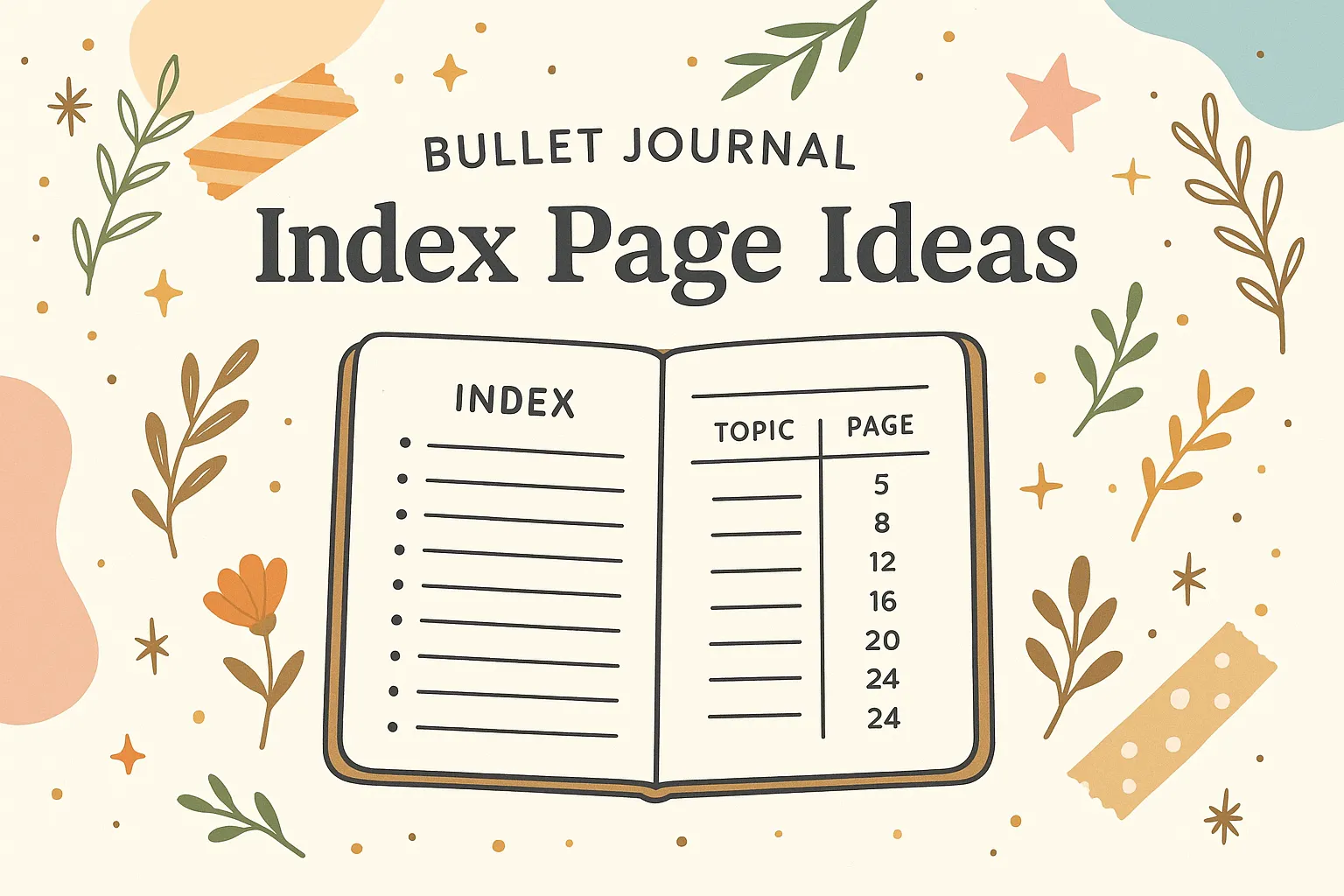
When you start a bullet journal, the first few pages decide how smooth your journaling experience will be. One of the most important pages is the Index Page.
Many beginners skip this step, but later they struggle to find their notes, trackers, and spreads. An index page works like a mini-table of contents for your journal. If you keep it neat and updated, your entire journal becomes easy to use.
In this blog, you will learn what an index page is, why it matters, and some creative index page ideas you can try. All explanations are simple and beginner-friendly.
Table of Contents
What Is an Index Page in a Bullet Journal?
An index page is usually one or two pages at the front of your bullet journal. It helps you record the page numbers and topics inside your notebook. For example, if your “Habit Tracker” is on page 14, you note it in the index so you can quickly find it later.
Think of it like a shortcut that saves time. Instead of flipping through all pages, you can directly go to the page you need.
Why Do You Need an Index Page?
Here’s why an index page is useful:
- Easy navigation: You can quickly find spreads and important notes.
- Better organization: It keeps your journal neat and structured.
- Saves time: No need to search page by page.
- Helpful for long journals: If you use your bullet journal for months, the index keeps everything in order.
Even if your journal is simple, adding an index page makes a big difference.
Bullet Journal Index Page Ideas
Below are some fun and practical index page ideas. You can choose any style based on your taste—minimal, aesthetic, creative, or functional.
1. Simple Minimal Index
This is the easiest and cleanest style. Just divide the page into two columns:
- Left: Page topic
- Right: Page number
This style works for students, professionals, or anyone who likes a clean layout. It doesn’t require drawings or colors. If you want your journal to look neat, a simple minimal index is perfect.
2. Aesthetic Index With Doodles
If you like art and creativity, add small doodles around the index. For example:
- Stars
- Leaves
- Flowers
- Books
- Moons
Use light pastel colors or brown brush pens for a soft look. This idea gives your journal a cute and warm vibe.
3. Color-Coded Index Page
In this idea, you use different colors for different categories like:
- Blue = Study pages
- Green = Finance and budget
- Yellow = Personal
- Pink = Self-care
- Violet = Goals
Make a small color key on the index page. Then add a colored dot or line next to each entry. This method is very helpful if you use your journal for multiple areas of life.
4. Category-Based Index
Instead of writing all entries together, divide your index into sections:
- Planning Pages (Monthly, Weekly, Daily logs)
- Trackers (Habit, Mood, Sleep, Reading)
- Lists (Books to read, wishlist, expenses)
- Notes (Important ideas, projects, tasks)
This style keeps similar pages grouped together. It’s a good idea for people who maintain many trackers and collections.
5. Illustrated Index Page
In this idea, instead of writing only text, you draw small icons. For example:
- A book icon for reading list
- A dumbbell for workout tracker
- A rupee symbol for budget tracker
- A heart for gratitude log
These small visuals make your index page fun and easy to scan quickly.
6. Fold-Out Index Page
If your journal doesn’t have many extra pages, you can use a fold-out index.
Just stick a small folded paper or a flap on the inside cover. This becomes your quick index that you can open anytime. This is useful for travelers, students, and people who like compact journals.
7. Two-Page Index Spread
If you plan to use your journal for several months, a single page may not be enough. A two-page index spread gives you more space. You can add more categories, colors, and entries without worrying about running out of room.
8. Vertical Index Page
Instead of writing entries horizontally, write them in a vertical list. This creates a modern and clean look. Use simple lines or grids to keep the page tidy. Many people prefer vertical index pages because they look more structured.
9. Index Page With Washi Tape
Washi tapes add color and design instantly. Use them to create:
- Borders around the index
- Category dividers
- Highlighted headings
Choose tapes with floral, travel, or pastel themes depending on your style. This idea is perfect if you like aesthetic journals but don’t want to draw.
10. Alphabetical Index Style
Make an index with A–Z sections. You can fill each letter with topics as your journal grows. For example:
- B – Books Read (p. 15)
- G – Gratitude Log (p. 22)
- M – Monthly Log (p. 3)
This idea works well for large journals or long-term notes.
11. Minimal Black-and-White Index
For a neat and professional look, keep the index fully black and white. Use thin lines, clean handwriting, and bold page numbers. This is ideal for office journals or study planners.
12. Grid-Style Index Page
Draw small boxes in a grid layout. Each box represents a page or category. You can fill boxes as you create new spreads. This looks modern and tidy.
Tips to Maintain Your Index Page

Your index page is useful only if you update it from time to time. Here are some tips:
✔ Number your pages from the beginning
If your journal doesn’t have printed page numbers, add them yourself.
✔ Update the index after every new spread
This takes only 5 seconds and saves time later.
✔ Use a bookmark
Keep a ribbon or clip on your index page for quick access.
✔ Keep space for extra entries
Don’t fill the entire page at once; leave gaps to add new topics later.
✔ Don’t over-decorate
A little decoration is fine, but too much can make your index confusing.
Also Read:
- Easy cute bullet journal ideas
- Bullet journal weekly spread ideas
- Bullet journal monthly spread ideas
- Bullet journal daily planner ideas
Final Thoughts
Your bullet journal index page is the backbone of your journal. It keeps everything organized and makes your journaling journey smooth. Whether you like minimal designs or creative spreads, choose an index style that fits your personality and needs.
Remember, bullet journaling is flexible. There is no right or wrong way—only your way. Start with a simple idea from this blog, customize it, and slowly build an index page that truly works for you.
If you want more ideas on bullet journaling, planners, and creative layouts, feel free to explore other posts!
