

Last updated on March 4th, 2026 at 07:13 pm

Have you ever set amazing goals for the new year, only to lose track after a few weeks?
You’re not alone.
Staying consistent with goals, whether it’s fitness, study, self-care, or business — can feel overwhelming. That’s where a bullet journal (or BuJo) comes to the rescue!
A bullet journal isn’t just a planner; it’s your personal command center, where creativity meets productivity.
You need to use it to set, track, and actually achieve your goals in a way that feels motivating instead of stressful.
So, if you’ve been wondering how to start a bullet journal to achieve your goals, and how to actually use it daily — this guide is for you. Let’s dive in!
Table of Contents
What Is a Bullet Journal?
A bullet journal is a customizable system created by Ryder Carroll. It’s designed to help you organize your thoughts, tasks, and goals in one place.
But what makes it special is that it’s flexible — you can use it for:
- Planning your day or week
- Tracking habits
- Writing affirmations or reflections
- Setting and breaking down goals
Think of it as a mix of a planner, a diary, and a vision board — all in one notebook.
You don’t need to be an artist or a productivity guru to start. All you need is a notebook, a pen, and clarity about what you want to achieve.

Step 1: Choose the Right Journal
Before you start, pick a notebook that feels comfortable and inviting.
What to look for:
- Dot grid notebook: The dots make it easy to draw lines, boxes, and trackers neatly.
- Medium size (A5): Portable yet spacious enough for daily journaling.
- Thick pages (120 GSM+): Prevents ink from bleeding through.
If you’re just starting, don’t worry about making it fancy — even a basic notebook will do. You can upgrade later once you know your journaling style.
Step 2: Clarify Your Goals
Before you draw a single page, pause and reflect:
What do I want to achieve this month, this year, or even this week?
Your goals can be:
- Personal: Building confidence, learning a new skill
- Professional: Starting a side business, getting a promotion
- Health-related: Exercising, eating better, sleeping early
- Creative: Drawing, journaling, or writing regularly
Write these down in your first few pages — this becomes your “Goals Overview” section.
Tip:
Use the SMART method (Specific, Measurable, Achievable, Relevant, Time-bound).
Example:
Goal: Get fit
SMART Goal: Walk 8,000 steps a day for 30 days straight
Step 3: Set Up Your Bullet Journal Layout
Now let’s design your BuJo so it helps you track those goals efficiently.
Here’s a basic structure you can follow
1. Index Page
This is your journal’s table of contents.
Number your pages and list them here — it makes navigation easy when your BuJo grows.
2. Future Log
A 6-month or yearly overview where you note down long-term goals, big deadlines, or dreams.
Example: “Complete online course by March,” “Start new project by June.”
3. Monthly Spread
Your month-at-a-glance page — perfect for:
- Writing your monthly focus or quote
- Listing main goals for the month
- Adding a small habit or mood tracker
4. Weekly Spread
This is your planning zone. Break big goals into weekly tasks.
Example:
- Week 1: Research gym memberships
- Week 2: Start a 20-min daily walk
Keep it simple — 7 sections for the week, or use two pages per week if you prefer more space.
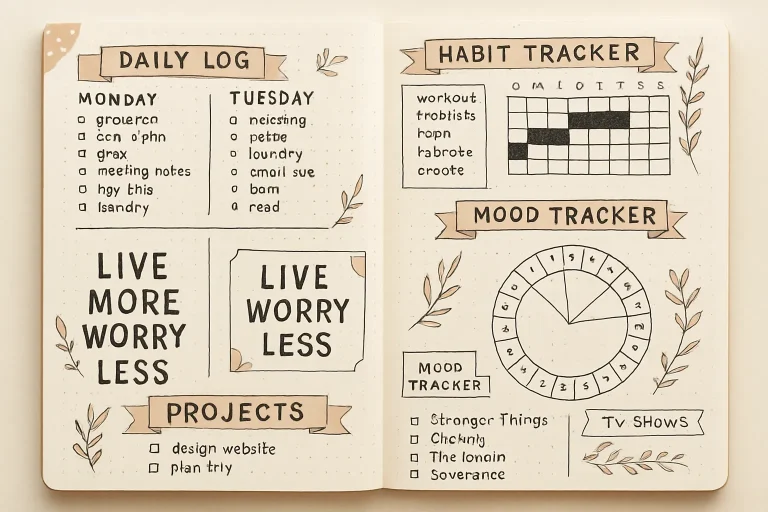
5. Habit & Goal Trackers
This is the most important spread in your BuJo to help you achieve our goals. It’s going to clearly show you how many times you’ve taken the step to develop that habit of yours or towards that goal of yours.
Create small grids to track daily progress like:
- Exercise
- Study time
- Reading
- Screen-free time
- Journaling
You can even create a “Goal Progress Bar” for each big goal — color it in as you get closer to completing it.
Step 4: Break Goals into Mini-Goals
Most people give up on their goals not because they lack motivation — but because their goals feel too big.
The trick is to break your main goal into smaller, achievable steps.
Example:
Main goal — Start a small online business in 3 months
Mini-goals —
- Month 1: Research niche & ideas
- Month 2: Create website & design logo
- Month 3: Launch & promote
Each mini-goal can then be split into weekly tasks in your journal.
This step-by-step breakdown keeps you from feeling overwhelmed — and shows visible progress!
Step 5: Make It Visually Inspiring
A cute or aesthetic bullet journal keeps you excited to use it daily.
You can decorate your goal pages with:
- Washi tapes and stickers
- Soft pastel highlighters
- Doodles related to your goals (plants growing for progress, stars for motivation, etc.)
- Positive affirmations like “You’re doing great!” or “Progress, not perfection.”
Even a few design touches can make journaling something you look forward to.
Step 6: Build a Daily Routine Around It
Creating the journal is only half the journey — using it consistently is where magic happens.
Here’s how to make journaling part of your day:
Morning Routine:
- Write your top 3 priorities of the day.
- Revisit your goals briefly.
- Add one affirmation that motivates you.
Example:
Today I will stay calm, focused, and productive.
Night Routine:
- Check off completed tasks.
- Reflect: What worked today? What can I improve?
- Update your habit tracker and write a short note of gratitude.
This daily connection builds awareness — and helps you stay aligned with your goals.
Step 7: Review & Reflect
Once a week or month, take 10–15 minutes to review your bullet journal.
Ask yourself:
- Did I make progress on my goals?
- What patterns am I noticing?
- Which goals need adjusting or redefining?
Use this reflection to set your next week’s priorities.

Example reflection prompt:
“This month, I noticed that I’m consistent with journaling but skipping workouts. I’ll shift to 15-min morning walks instead of one-hour sessions.”
This flexibility keeps your goals realistic and sustainable.
Step 8: Use It as a Mindset Tool
Your bullet journal isn’t just for tracking — it’s also a tool for self-motivation and mental clarity.
Here’s how you can use it beyond to-do lists:
- Vision Board Page: Paste or draw what success looks like for you — travel photos, inspiring words, etc.
- Gratitude Log: Write one thing you’re grateful for daily to keep your mindset positive.
- Affirmation Page: Write affirmations that align with your goals — e.g., “I’m capable of achieving my dreams.”
- Progress Journal: Celebrate wins — no matter how small!
When you pair planning with positivity, your bullet journal becomes your personal coach and cheerleader.
Step 9: Stay Consistent (Even When You Miss Days)
No one uses their bullet journal perfectly every day — and that’s okay.
If you miss a day (or a week), simply start again. The beauty of a bullet journal is that there are no fixed dates — no wasted pages, no guilt.
You can always pick up where you left off and refocus your goals.
Remember: Progress isn’t about perfection — it’s about showing up more often than you don’t.
How to Use Your Bullet Journal to Actually Achieve Goals
Let’s put it all together. You’ve made your journal, set your goals, and filled in trackers.
Now here’s how to use it effectively every day:
- Start your morning by reviewing your goals.
This keeps your “why” fresh in your mind. - Plan small daily steps.
Instead of writing “Work on project,” write “Finish 1 section of project.” - Check off completed tasks.
That satisfying “✔️” builds motivation — you’ll crave that feeling daily. - Track your habits visually.
Seeing a streak of colored boxes motivates you to stay consistent. - Reflect weekly.
Adjust what’s not working instead of quitting altogether. - Celebrate milestones.
Use a “Win Log” page to list every success — from finishing a book to achieving your first fitness goal.
By the end of a month or year, you’ll not only see your progress — you’ll feel it in your confidence and routine.


Final Thoughts: Your Bullet Journal Is Your Growth Companion
When you start a bullet journal, you’re not just creating pages — you’re building a personal system for success.
Every line, doodle, and note becomes part of your journey.
Whether your goal is to grow a business, practice self-care, or build a consistent habit — your bullet journal can guide you every step of the way.
So grab a notebook, write your first goal, and remember:
Small steps each day lead to big changes over time.
Your future self will thank you for starting today.
Learn creative ways to design and decorate your BuJo pages beautifully!
